The Macro Shift
Say "Mysuru" and most people picture the same postcard: the Palace lit up gold, clean air, a slow, relaxed pace - a weekend getaway, not a business address. That image is now officially outdated.
In January 2026, a Gazette Notification quietly rewrote the city's future, birthing the Greater Mysuru City Corporation (GMCC). The numbers alone tell the story: the city's physical footprint exploded fourfold, from 86.31 sq. km to 341.44 sq. km, with population rocketing toward 15 lakh. This isn't organic drift - it's structural re-engineering. MUDA Commissioner A.N. Raghunandan has called it a "paradigm shift in urban growth," part of a deliberate 50-year vision for the region.
The state government has backed this with policy weight - Karnataka's 2026 Budget explicitly designated Mysuru as the state's "second IT city" and "second technology capital" after Bengaluru, channeling serious support toward Global Capability Centres and tech clusters here.
The momentum shows on the ground too. At major industry gatherings this year - from TiECON 2026, IT-entrepreneurship summits to CII's Annual Meet - industry leaders have openly called Mysuru's current moment a powerful inflexion point.
The economic fundamentals back the noise: a high ₹3,59,177 average per capita income, and a dominant 64.03% Services sector share.
The city has grown up. Capital is flowing. Infrastructure is expanding. So here's the real question facing Mysore businesses today: if the city is scaling this fast, why are local brands still relying on outdated, passive marketing - rather than partnering with a specialized marketing agency in Mysuru equipped to capitalize on this exact inflexion point?
The Multi-Tier Growth Wave: The Spillover Effect
Mysuru's boom isn't confined to a few corporate IT boardrooms. It's a multi-tier tidal wave, spreading outward into a hyper-connected Greater Mysuru region - and it's happening in the backyard of every local business, not just the anchor players.
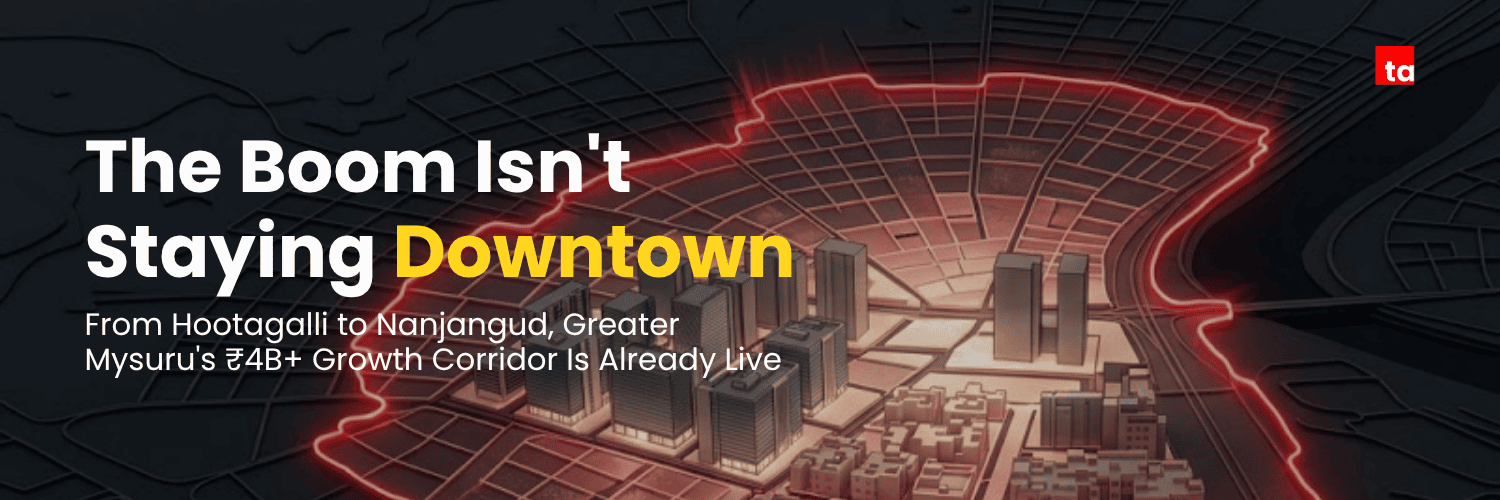
Shift your focus beyond the historical city center. The Local Planning Area has ballooned from 509 sq. km to 1,200 sq. km, physically integrating high-growth zones like Hootagalli, Bogadi, Srirampura, Kadakola, and the Srirangapatna and Nanjangud taluks into one synchronized regional economy — not isolated pockets of growth, but a connected engine, where activity in one corridor now visibly reinforces the next.
The financial validation behind this is heavy-hitting. Nanjangud Industrial Area isn't just a manufacturing zone - it's a provincial giant, ranking as the 2nd highest VAT/Sales Taxpayer zone in Karnataka, trailing only Peenya in Bengaluru, and yielding over ₹4 billion (~$47M) in tax contribution alone. The ecosystem here is diverse and heavily capitalized: heavy-industry anchors like BEML, Kirloskar, Automotive Axles, AT&S, Nestle, and TVS, sitting alongside tech anchors like Infosys, Wipro, and L&T - proof that this isn't a single-sector bet, but a genuinely layered economy. Even infrastructure execution is accelerating to match: the Peripheral Ring Road project shifted from a slow PPP model to direct EPC responsibility, a clear signal that physical bottlenecks to scaling are actively being dismantled, not just discussed.
Now tie this industrial expansion to the people living inside it. This is where India's demographic dividend stops being an abstract macroeconomic figure and becomes a localized competitive superpower: a remarkably young median age of 28–29 years, and a projected 24.3% contribution to the global incremental workforce over the next decade.
Historically, Mysuru's brightest minds packed their bags for Bangalore's tech hubs the moment they graduated, chasing opportunity the hometown couldn't yet offer. Today, because of this infrastructure wave, that equation is flipping - a highly skilled, cost-effective local workforce can thrive right here, giving Mysore businesses direct access to talent they once had to compete with Bangalore to retain.
Here's the realization every local business owner needs to sit with: as workforce, infrastructure, and consumer purchasing power all migrate toward these peripheral zones, the traditional ways of reaching them - standard local billboards, central-city networking - are fracturing in real time. Reaching this dispersed, fast-growing audience now requires exactly the kind of precision only a specialized marketing agency near Mysuru is built to deliver.
The Threat of the "Digital Noise": The Core Problem
The growth story from the previous section isn't just good news - it's a direct warning. Translate the physical expansion into what it actually means for established Mysore businesses: an incoming wave of aggressive new players, armed with modern digital budgets, about to compete for the exact same customers you've served for years, in your own backyard. To understand why, follow the money first.

The Capital Flood
The state's official "Beyond Bengaluru" policy, backed by the targeted "Spoke-Shore" job-creation project, isn't abstract policy language - it's real money, moving right now. The proof is staggering: the ₹22,900 crore ISMC Analog Fab project at Kochanahalli, poised to become India's largest semiconductor unit, alongside the newly approved ₹3,425.60 crore Zoho-backed Silectric Semiconductor electronics manufacturing cluster. Industry voices project these anchors could pull in up to ₹80,000 crore in follow-on investment - capital that doesn't stay contained to one factory floor, but spreads through the entire regional economy.
The Birth of the "Vendor Layer"
That ripple is where the real threat begins. These billions translate directly into hundreds of real, aggressive ancillary companies — testing facilities, packaging firms, embedded-technology suppliers — moving into the local geography right now. Unlike the legacy businesses already here, these incoming players are digitally native, heavily funded, and hunting for local market share from day one, with none of the hesitation older businesses carry.
The Cluttered Reality: Defining Digital Noise
Multiply that by hundreds of new entrants launching budgets simultaneously, and you get the crisis facing Mysore businesses: digital noise. The local attention ecosystem is about to get deafening. A brand relying solely on slow word-of-mouth, or buried in identical squares on a crowded newspaper page, will simply be swallowed by the volume. Building genuine brand visibility Mysore consumers actually notice — real digital presence Mysore audiences trust - isn't optional anymore. This window to stake your claim is strictly time-bound, and it's closing faster than most realize.
The "Bangalore Agency" Trap: Losing the Hyper-Local Edge
The Strategic Local Counter-Move: The Solution